The Gospel according to Mark, Chapter 7 (1-23)

(white doves -> Peace)
<--Symbole des Christentums
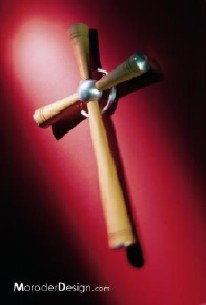
(cross)

(Kronleuchter)
<--Symbole des Judentums
 (Davidstern)
  <-- Jude mit traditioneller Kopfbedeckung
 Bilderquellen:
www.christentum.ch
www.jrencontre.com
www.exil-club.de
www.vegetarismus.ch
www.glaubenslichter.de
The Gospel according to Mark, Chapter 7 (1-23)
1 The Pharisees and some scribes who had come from Jerusalem, held on to Jesus.
2 saw that some of his disciples their bread with impure, that is eating with unwashed hands.
3 The Pharisees namely, how to eat all the Jews only if they have been washed with a handful of water, the hands, as required by the tradition of the elders.
4 Even if the market come, they eat without washing first. Many other traditional rules to keep them, as the washing of cups, jugs and kettles.
5 The Pharisees and the scribes asked him: why keep your disciples not to the tradition of the elders, but eat their bread with impure hands?
6 He said to them: The prophet Isaiah was right with what he said about you hypocrites: This people honors me with their lips, his heart is far away from me.
7 It is meaningless as they worship me, they teach are human precepts.
8 Your price give the command of God and keep to the tradition of the people.
9 And again Jesus said: Very cleverly uses her God's command out of power and keep to your own tradition.
10 Moses said, for example: Honor thy father and thy mother, and: who cursed father or mother shall be put to death.
11 My but teaches: It is permissible for a man says to his father or his mother: What do I owe you is Corban, that is, an offering
12 This it prevents him something for his father or mother . do
13 Thus it is through your own tradition, God's word out of power. And it is similar in many cases.
14 Then he called people came to him and said, Hear me all and understand what I say
15 Nothing that enters from outside a man can make him unclean, but what comes out of the man that makes him unclean.
16/17 He left the crowd and went into a house. As his disciples asked him about the meaning of this mysterious word.
18 He answered them, does not understand too? Do you not one, that what goes in from the outside in the man, it can not defile
19 For there's not get into his heart, but in the stomach and is excreted. Thus he declared all foods clean.
said 20 Next He: What comes out of a man is what defiles a man.
21 For from within, out of men's hearts, come evil thoughts, fornication, theft, murder, adultery, covetousness, wickedness, deceit, envy, slander, arrogance and foolishness.
23All these evil things come from within and defile a man.
comment by Antonia Keßelring
The pericope head in Mark's Gospel to a whole series of stories about where deals Jesus and the calling of the Gentiles, and at the same time separated completely from the Pharisees and the scribes of his people. The author of the Gospel is a Christian and Heath writes for a community of Gentile Christians. Therefore, he and his congregation on the clarification of these issues a special interest: are they that used to Gentiles and to know the Jewish law, not against the Jews, Christians, something like "Christians second-class" Who are the Pharisees and scribes? The Judaism of Jesus' time was a diverse religious landscape in which it so was pretty much it. One
all had in common: In the center of the faith was the Temple in Jerusalem. This is meant not only metaphorically, but quite tangible: On high festival days he was the target of Jewish pilgrims from all over the Mediterranean. There was brought to his victims dar. Under the Roman domination The temple was a symbol of the identity of the Judentums.Davon now moves the renewal movement of the Pharisees from a little and put more emphasis on the observance of religious laws and social rules from the Old Testament. It is by no means blind obedience to them: for hours debating and arguing representatives of various schools of Pharisaic heavily on the interpretation of individual provisions.
What instructions are adhered to? Which are secondary? When that law can be ignored? What the general is the top priority, according to which all others will be be judged? Jesus also deals with these issues. His attitude is to the Jewish law, a very hypocritical, no matter what may have been said later. The bid must be discussed emotional and overflowing, and Jesus takes a stand and defend it vigorously. He discussed in Mark 12:28-34 about which is the highest priority - and comes across very well received a scribe!
Another example is the present pericope, which is concerned to comply with some dietary laws. argues that Jesus and the Pharisees about the Torah, that is not a sign of hostility, but rather shows how much he has with them hat.Was separates them is on a different level. The Pharisees strong efforts to their ritual purity. Be careful not to violate food laws and other ritual commandments, such as fasting on certain days and circumcision.
Such ritual rules that exist in every religion, regulate, not the human community, but serve to preserve the religious identity: Who are these rules, often from outside are not reasonable, observed, differs from the others and professes to be a member of the Jewish / Christian / Hindu religion. For a small religious group in the middle of a powerful, much more impressive foreign culture to help those rules to distinguish themselves from other religions. In this situation, Judaism in the ancient Near East has always been and it is also the time of Jesus. Therefore, these ritual commandments no laughing laborious task, but guarantee the survival of Judaism and the Yahweh religion in the superior Hellenistic culture.
The Pharisees are so concerned about purity. This also means that they do differ distinguish strict and, not only of other faiths (the Gentiles), but also of Jews who have rendered "unclean" by their way of life: tax collectors, prostitutes, thieves, lepers and sinners in general. Of these people, they stay away because they think this impurity for contagious: The contact with these "outcasts" defile. It is now radically different Jesus from the Pharisees. He lives without that line, and knows no fear. As we learn from this pericope is that with the fact that he re-interpreted what you have meant by pure and impure. From other passages we learn: The fair, which places Jesus especially in dealing with the "unclean" outcasts of the day, free, and changed it. It is contagious. And she brings in all, Jews and Gentiles, Pharisees and tax collectors.
Source:
http://www.redemptoristen.at/magazin/artikel.php?artikel=776&menuid=38
Katharina Reschke, Lisa Penzkofer, Tobias Müller, Lukas Moule <3


0 comments:
Post a Comment